NAD+ Therapy: What It Is and What the Research Says
We are living in an era of hyper-wellness, it’s all around us. Whether it’s the Pilates class nearby or the protein-rich recipes on your FYP. Health and wellness have reached a peak time high, and we’re all in the pursuit of healthy aging. People are increasingly realizing that our living conditions are not how they were and our bodies are constantly getting impacted by the deteriorating environmental conditions around us.
That is why NAD+ therapy has become popular in the field of longevity research. Medical experts are increasingly researching the coenzyme and trying to understand its place in longevity and how it can influence the overall vitality and cellular function of an individual.
Some sources on the internet may claim that NAD+ can be the next fountain of youth, but they don’t always paint the full picture. In this blog, we take a look at what NAD+ is, how it functions, and what uses people can get out of it.
What is NAD+ and how does it work?
The full form of NAD+ is nicotinamide adenine dinucleotide, but it’s just better known as NAD+. It’s a coenzyme that’s found in every cell that’s living. You may hear about it in discussions that talk about healthy aging or anti-aging, but the primary function of NAD+ is to basically help cells in producing the energy that they need to produce.
The long and short of it is that NAD+ helps cells make energy. That’s the short version. Every cell in the body is constantly converting food into usable energy, and NAD+ is one of the molecules that shuttles electrons around during that process. Every single bodily function of yours, like a single heartbeat, muscle contraction, or nerve signal, depends on how well your body is able to convert the nutrients into cellular energy that can be used by the body.
Without NAD+, the whole energy-making chain basically stalls. We all know that the mitochondria are a powerhouse of the cell. That’s basically where NAD+ works.
It’s involved in something called cellular respiration. Mitochondria need NAD+ to do their job. No NAD+, no functioning mitochondria, no energy. There’s also this enzyme family called sirtuins that depend on NAD+ to function, and sirtuins are tied to things like DNA repair. So it’s not just an energy thing. It’s also a repair thing.
These processes become less and less efficient as an individual ages. That’s why proper NAD+ functioning is such an important topic in research on aging.
What is NAD+ therapy?
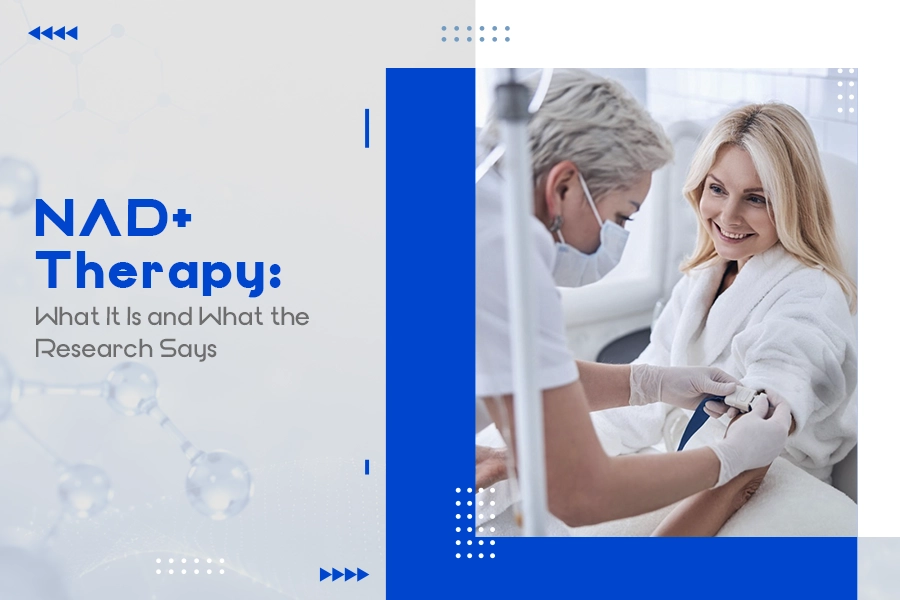
NAD+ therapy is a set of treatments used to increase the availability of NAD+ in the body. NAD+ may be delivered through IVs, injections, or even oral supplements. Popular treatment methods are IVs and injection. They are used by multiple researchers who are constantly studying it.
The main aim of these treatment methods is to restore the NAD+ levels at the cellular level. Research is still being conducted on how effective injected NAD+ is and which tissues it’s able to reach and influence.
Sometimes there’s a confusion between NAD+ and NADH. NAD+ is the oxidized form. NADH is the reduced form. They convert back and forth constantly inside cells, kind of like a rechargeable battery flipping between charged and discharged states. Both forms matter. People usually talk about NAD+ specifically because that’s the form involved in a lot of the signaling and repair pathways researchers are focused on right now.
NAD+ is synthesised from precursors like niacin (vitamin B3). It’s one of the more well-known ones. There are a few different pathways the body uses, some more efficient than others depending on which starting material is available.
Diet plays a role here too, since niacin comes from food. Tryptophan, an amino acid, can also be converted into NAD+ through a separate pathway, though it’s a less direct route.
Potential uses of NAD+
Research is constantly being done on NAD+ since the interest in the coenzyme has grown exponentially over the decades. NAD+ can play an important role in a few physiological functions. We’ll elaborate on a few potential uses that are being studied.
ATP is basically the energy currency of your cells. You need ATP, technically called adenosine triphosphate, to function, repair, and survive. NAD+ plays an important role here since it helps the cells in converting nutrients into ATP. This ensures that there’s sufficient cellular energy in the body to function.
Research is also constantly being done on how increasing the NAD+ levels can influence the biological markers of aging. Preclinical studies did show some optimistic results, but human studies still show inconclusive data to make any solid conclusions. More research needs to be done on this particular avenue to get solid evidence on its anti-aging properties.
NAD+ has also been implicated in metabolic health. Some studies have suggested that increasing the availability of NAD+ can increase insulin sensitivity in the body and support the function of mitochondria. This can be particularly beneficial for people who live with metabolic dysfunctions. Human studies show mixed results as of yet, and larger clinical trials are needed for solid conclusions.
Lastly, NAD+ has also been studied to see if it’s beneficial in maintaining neuronal health and protecting cells from oxidative stress. Like the previous findings, it needs more research and data since the findings haven’t yet been able to provide us with some solid data.
Safety of NAD+ therapy
The studies that have been done on NAD+ and its effects don’t necessarily show any huge complications. NAD+ is generally well tolerated when it is administered appropriately. You may experience a few side effects like such:
- Moderate nausea
- Flushing
- Headaches
- Tiredness
- Momentary discomfort where the injection was administered.
The long-term safety of this coenzyme is still being studied, so NAD+ should always be used under the appropriate supervision of a medical expert.
Final Thoughts
It’s easy to read about NAD+ and start thinking of it as some kind of miracle molecule. It isn’t. It’s a working part of basic biochemistry that every single cell depends on, which is exactly why interest in it keeps growing.
Calling it “essential” isn’t marketing language here, it’s the literal biochemical role. Cells don’t function properly without it.
That said, more research is still needed before drawing big conclusions about supplementation, anti-aging claims, or long-term outcomes. The basic science is solid. The extrapolations people make from it are a lot shakier.
FAQs
1. Is NAD+ a vitamin?
No, it’s a coenzyme made from vitamin B3 and other precursors, not a vitamin itself.
2. Does NAD+ really decline with age?
Yes, studies generally show levels drop as people get older.
3. What foods help with NAD+ production?
Foods with niacin, like meat, fish, and some legumes, support natural NAD+ synthesis.
4. Are NAD+ supplements proven to work?
Human research is still limited; animal studies show more promise so far.
5. Is NAD+ the same as NADH?
No, NAD+ is the oxidized form, and NADH is the reduced form of the same molecule.