
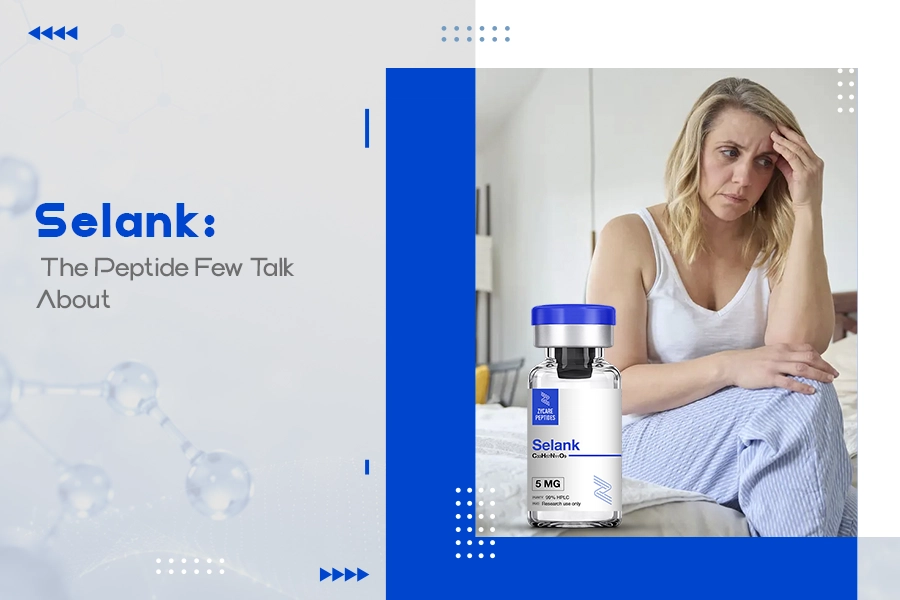
So I’ve been falling down a rabbit hole lately. Started with looking into nootropics, you know how that goes and somehow ended up deep in Russian pharmacology papers from the early 2000s. That’s where Selank keeps showing up. And honestly? Strangely, more people in the US and UK aren’t talking about it, at least not in mainstream research circles.
Let me try to explain what I’ve gathered so far, with the caveat that this is a research deep dive, not medical advice or anything close to it.
What Is Selank
At its most basic level, Selank is a synthetic heptapeptide, meaning it’s a chain of seven amino acids with the sequence Thr-Lys-Pro-Arg-Pro-Gly-Pro. It was developed at the Institute of Molecular Genetics of the Russian Academy of Sciences. Originally researched in Russia, it was designed to modulate brain function and support immune response.
The interesting part is that it’s structurally derived from tuftsin, which is a naturally occurring immunoregulatory peptide in humans. So it’s not some totally alien compound, it’s more like a modified version of something the body already knows, just tweaked and extended.
People sometimes describe it as a nootropic-anxiolytic hybrid. Which sounds like marketing language, but actually lines up with what the research shows.
The Anxiety Side of Things
Okay, this is where it gets genuinely interesting. Clinical studies, actual human trials, not just rats, found that Selank’s anxiolytic effects were comparable to benzodiazepines like Medazepam. Comparable. That’s a loaded word in psychopharmacology.
The difference, and it’s a significant one, is what Selank apparently doesn’t do. No sedation. No cognitive dulling. No dependency or withdrawal symptoms. Benzodiazepines are notoriously rough on all those fronts, so the fact that Selank seems to sidestep those issues at least in the research so far is what makes it unusual.
One clinical study out of Russia looked at 62 patients with generalized anxiety disorder (GAD) and neurasthenia. Thirty of them received Selank, and 32 received medazepam. Both groups showed comparable improvements on anxiety scales. But the Selank group also showed antiasthenic and psychostimulant effects that medazepam didn’t produce. Which… that’s not what you’d expect from something that’s supposed to calm you down.
How It Actually Works
This part gets complicated, and I don’t fully follow all of it. But the general picture from the research is that Selank works through several overlapping mechanisms rather than one clean pathway.
There’s the GABAergic angle. Selank appears to modulate GABA-A receptors, which is the same general territory that benzodiazepines work in. But its interaction is different, more of a positive allosteric modulation rather than a direct hit on the receptor.
Then there’s the serotonin piece. Research suggests it may act as a selective serotonin transporter inhibitor, which is a territory that SSRIs occupy. Selank also seems to correct serotonin metabolism and boost BDNF (brain-derived neurotrophic factor), which is basically a protein that supports neuron survival and growth.
BDNF matters more than it gets credit for. Low BDNF levels are associated with depression, cognitive decline, and stress vulnerability. So the idea that a compound might elevate BDNF while simultaneously reducing anxiety, without sedating the person, is… well, it’s why researchers keep circling back to this thing.
The Cognitive Enhancement Question
I keep seeing Selank labeled as a nootropic, and there’s actually decent preclinical evidence for that.
One study from 2003, admittedly on rats, looked at how Selank affected learning and memory in animals with initially low learning ability. The results showed significant improvement in correct solutions and a reduction in errors, with effects building across repeated doses. They also compared it to piracetam, which is kind of the granddaddy of nootropics, and the dynamics of how Selank worked were notably different in timing and mechanism.
There’s also some human-side data suggesting improvements in attention, memory, and focus, including reported benefits in conditions like PTSD and ADHD in one NIH-referenced study. A lot of the foundational research on Selank comes from Russian institutions, and Western replication is still limited. That doesn’t invalidate the findings, it just means the picture isn’t complete yet.
Something That Doesn’t Come Up Enough: The Immune Connection
Most of the conversation around Selank in Western research communities stays in the brain. Anxiety, cognition, BDNF. But because it’s derived from tuftsin, which is immunomodulatory, Selank also appears to have immune effects.
Specifically, it seems to modulate IL-6 expression and affect the balance of T helper cell cytokines. These aren’t small things. IL-6 is a cytokine with wide-ranging effects on inflammation, and T helper cell balance matters enormously in immune regulation.
This part of the research is less developed than the neurological side, and I genuinely don’t know where it’s going. But it adds a layer to Selank that makes it more than just a “chill-out peptide,” if that framing even makes sense.
N-Acetyl Selank – Is It Just Selank With Extra Steps?
At some point in any deep dive on Selank, N-Acetyl Selank shows up. It’s an acetylated version of the same heptapeptide. The acetylation theoretically increases stability and bioavailability, which matters practically because peptides degrade.
Research on N-acetyl selank suggests it may have enhanced potential for influencing serotonin signaling, BDNF expression, and enkephalin activity in the central nervous system. Enkephalins are endogenous opioid peptides that play a role in pain modulation and mood, and the fact that Selank (and its acetylated form) seems to interact with that system might partly explain the antiasthenic effects seen in clinical trials.
It’s a newer area of investigation. Whether the acetylated version is meaningfully superior to the base compound for any particular outcome isn’t settled yet.
The Part That Stays Uncomfortable
Here’s what I keep sitting with: Selank has been approved for medical use in Russia. It’s been studied in clinical trials. It has a reasonable mechanistic story. And yet it sits in a kind of grey zone for most of the Western research world.
Part of that is that structural drug approval pathways in the US and UK are slow and expensive, and there’s no financial incentive for a pharmaceutical company to push through a compound they can’t patent in any meaningful way. Part of it might be genuine scientific skepticism about the robustness of the clinical data, much of which comes from a single national context.
It doesn’t mean Selank is some miracle molecule people are ignoring for suspicious reasons. It just means the research is at an interesting stage, with enough evidence to generate real curiosity, not enough to draw firm conclusions.
Where Things Stand Right Now
Selank research is ongoing, particularly in the domain of peptide-based neuropsychiatric compounds. The interest from Western research groups appears to be growing, slowly.
The compound continues to be studied for generalized anxiety disorder, cognitive enhancement, immune modulation, and increasingly for its neuroprotective properties, especially the antioxidant enzyme modulation angle and anti-apoptotic effects that some in vitro work has flagged.
It’s not a finished story. If anything, it reads more like chapter three of a longer investigation. The early data is promising enough that dismissing it seems premature, but anyone telling you Selank is definitively this or that is outrunning the evidence.
What I find genuinely compelling is the profile of what it doesn’t seem to do no sedation, no addiction potential, and no obvious cognitive downside in a landscape where most psychoactive compounds come with a fairly long list of tradeoffs. Whether that profile holds up as the research matures is the actual question.
FAQs
- What is Selank peptide used for in research?
Selank is primarily researched for its anxiolytic, nootropic, and immunomodulatory properties, particularly its effects on anxiety, memory, and BDNF levels.
- Is Selank the same as a benzodiazepine?
No. It shows comparable anxiety-reducing effects in studies but doesn’t cause sedation, dependence, or withdrawal.
- What does BDNF have to do with Selank?
Selank appears to elevate BDNF, a protein critical for neuron health and mood regulation, which may explain some of its cognitive and antidepressant-adjacent effects.
- Is Selank approved in the US or UK?
No. It’s approved for medical use in Russia but remains in a research/investigational context in Western countries.
- What’s the difference between Selank and N-Acetyl Selank?
N-Acetyl Selank is an acetylated form with potentially better stability and bioavailability, though research comparing the two directly is still limited.