
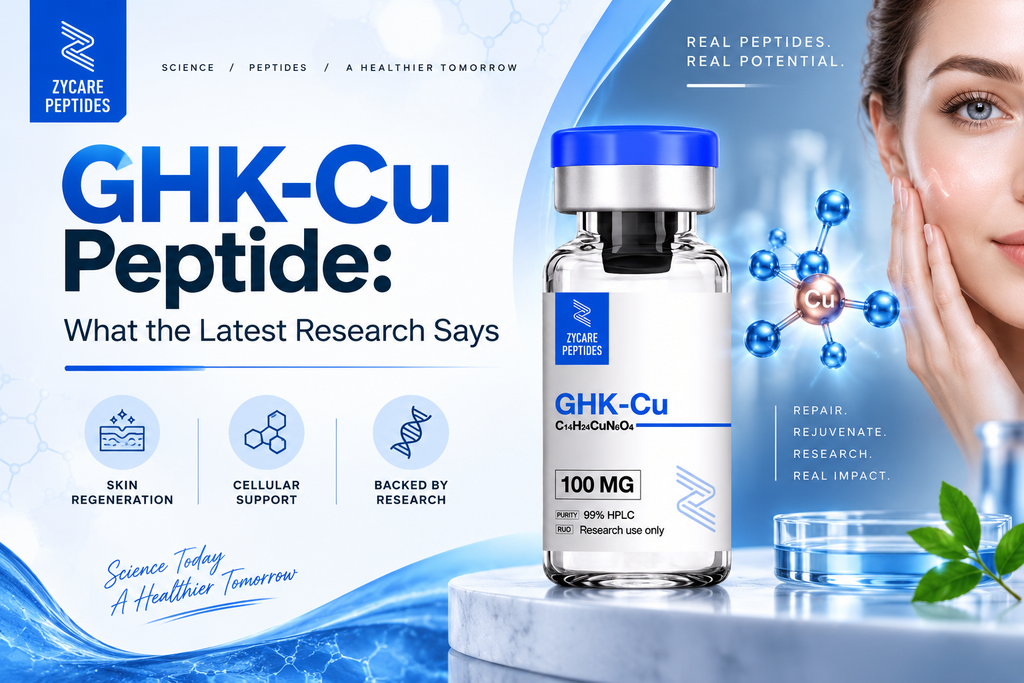
GHK-Cu is among the most prominent copper peptides currently used in skin and wellness research. It can be found in serums, in dermatology journals, and, more recently, in the realm of regenerative medicine.
But do you know what human studies on GHK-Cu peptide show? In this blog post, we are going to look at what GHK-Cu peptide research studies indicate, its possible human uses, benefits, evidence, and current regulatory standards in simple words.
What Is GHK-Cu?
GHK-Cu is an abbreviation for glycyl-L-histidyl-L-lysine copper complex. GHK-Cu is a naturally formed tripeptide combined with a copper ion.
GHK was first isolated from human plasma in the 1970s. GHK was found by scientists to form a complex with a copper ion naturally.
It might come as a bit of a surprise to you, but this peptide is actually found in the human body. We now know through research studies and experiments that this peptide is naturally present in our blood, saliva, and urine. One interesting fact that came out of research is that this peptide concentration remains high, usually in younger individuals, and reduces on aging.
How GHK-Cu Works in the Body
GHK-Cu Peptide is mostly associated with tissue remodeling. Some laboratory research has uncovered the following mechanisms of action of this compound.
Support of collagen and elastin production
It was found that GHK-Cu is able to stimulate fibroblasts, which are the skin cells that produce collagen and elastin, the compounds that provide the skin structure and elasticity.
Antioxidant properties
GHK-Cu seems to be involved in the regulation of copper-dependent enzymes/antioxidants, such as SOD (superoxide dismutase).
Anti-inflammatory action
There are some indications that GHK-Cu may have an effect on inflammatory processes, hence one of the possible mechanisms of its action in wound healing.
Effects on gene expression
The newer studies focus on the genomic effects of GHK-Cu on gene expression that could be related to tissue regeneration.
The thing is, much of the mechanism here is obtained through in vitro studies. This shows how GHK-Cu works on a cellular level, yet this does not automatically imply any clinical efficacy in humans. For this, we require human trials – a much smaller and more restrictive set of evidence.
What Human Research Actually Shows
This is where it really counts, and where many web pages get careless. This is an honest appraisal of the human research. Topical application and skin appearance
Topical use and skin appearance
The best human GHK-Cu research shows its viability and possible uses for topical, cosmetic-grade uses. A few small-scale human trials have used copper peptide creams and serums on human facial skin.
These studies usually measure things like wrinkles, skin tone, and skin texture after the product is used every day for a few weeks to months. The findings from these studies have been somewhat promising for the aesthetic appearance of the skin.
It is important to keep in mind that most of these studies have been small in size, sponsored by the cosmetics industry, and have lasted for a short time.
Wound healing research
GHK-Cu is also being investigated with regard to wound healing, primarily based on its impact on collagen production and tissue repair found in experimental settings. Clinical trials on wound healing conducted on humans are fewer compared to studies on skin appearance and are still at an early stage.
Hair and scalp research
Research on the use of GHK-Cu on hair density has increased somewhat because of its involvement in tissue remodeling. There is still a need for good studies to be done on humans regarding the use of GHK-Cu for hair growth.
What we don’t yet have
Currently, we don’t have any large-scale and long-term human studies where GHK-Cu has been shown to reverse the aging process or regenerate tissues in a placebo-controlled setting. We just don’t have that kind of evidence for this particular peptide yet.
GHK-Cu’s Regulatory Status
It is important to understand the standing of GHK-Cu within regulatory agencies; this is key context, not a detail to be glossed over in passing.
GHK- CU and FDA approval
GHK copper peptide has been approved by the FDA as an over-the-counter or prescription drug that treats any medical condition, such as skin aging, hair loss, or wounds.
Topically applied cosmetic GHK-Cu (such as the kind that is found in over-the-counter serums or creams and usually listed as copper tripeptide-1) is classified as a cosmetic, not as a drug.
Injection or compounded GHK-Cu is a drug that is regulated differently because of its high level of risk. The drug was not approved by the FDA, and there were some questions regarding safety and quality when it comes to injection and compounded injections of this product.
GHK-Cu Used Only for Scientific Research Studies
GHK-Cu used for scientific purposes, which is available from peptide manufacturers, is specifically labeled to be used only for laboratory study and not for internal consumption. There is an explanation for this labeling; these products have not been checked for safety and applicability for the human body in any other context.
As a matter of fact, if one studies GHK-Cu, industry sources such as the Zycare Peptides blog are just one aspect of the larger picture of educational materials in this area, together with the literature published in clinical literature on PubMed and FDA guidelines.
Safety Considerations
The safety data on topical GHK-Cu in cosmetic concentrations is quite well established in the scientific literature, although irritation of the skin may be a problem for some users.
When it comes to systemic administration of GHK-Cu, this opens an entirely new set of safety concerns regarding purity of the drug and its effects that have yet to be researched in human trials.
Copper is an important mineral; however, there could also be too much of it. As per regulatory standards on copper peptide research, scientists say that it needs to be used only after a careful consideration with the doctor.
Those who suffer from copper metabolism disorders, like Wilson’s disease, need to be especially careful and consult with a doctor before using copper products.
Just as in the case with other active ingredients in skincare or health care products, it is always advisable to consult a doctor first if you are expecting, breastfeeding, or suffering from chronic conditions.
The Bottom Line on the Evidence
GHK-Cu is an interesting compound that has a substantial history of scientific study going back several decades. Its function in copper biology and tissue remodelling is clearly established at the cellular level.
The area where the data is best substantiated is for topical applications in cosmetics for skin appearance, supported by a small but definite amount of human clinical data.
However, the weaker aspects of the data are in relation to wound repair, hair growth, and regeneration, which have been substantiated mainly by animal studies.
Conclusion
The case can indeed be made for GHK-Cu’s position in skincare discourse, based on decades of studies that show the mechanism of action of the compound in human cells, as well as on a solid, albeit small, body of clinical evidence for its applications in cosmetics.
However, any proper scientific discussion should be accompanied by an honest admission of the boundaries of our knowledge. Many of the grand claims regarding GHK-Cu, including its role in tissue regeneration and reversal of the aging process at large, and even in restoring hair, go beyond what is currently supported by the human clinical data.
For those considering GHK-Cu, the most sensible and well-documented route to take personally is the topical cosmetic product, possibly following a discussion with your dermatologist or physician regarding skin objectives and existing medical conditions. For those more interested in laboratory or scientific GHK-Cu research, some good sources for getting further into the literature include PubMed, FDA, and the supplier’s educational site, including Zycare Peptides.
Frequently Asked Questions
Is GHK-Cu FDA-approved?
No. GHK-Cu is not FDA-approved as a drug for any disease. Topical GHK-Cu that is cosmetic grade is considered a cosmetic product, whereas injectable and research grade are not approved for use by humans.
How does GHK-Cu benefit the skin?
Cell culture studies indicate that GHK-Cu stimulates the production of collagen and elastin and antioxidants in skin cells. Human studies using topical GHK-Cu have demonstrated slight improvement in skin firmness and texture.
Does GHK-Cu have the same meaning as copper peptides in cosmetics?
Indeed it does. “Copper tripeptide-1” is an alternative name used in the cosmetics industry for GHK-Cu in the formulation of serums and creams.
Is it possible to consume GHK-Cu orally or to get it through injections?
Yes, there are oral and injectable types, but none of them has been approved by the FDA. However, injections can be administered only by a physician.
GHK-Cu – Is It Safe?
When using topical GHK-Cu in cosmetics, one can expect a positive safety profile with only minor cases of irritation as the main adverse effect. However, when it comes to systemic administration and injection, there are many uncertainties regarding the safety profile that hasn’t been well studied in humans.
How does GHK-Cu differ from other peptides, including popular ones like BPC-157?
The thing is that GHK-Cu is investigated for remodeling skin and tissues via copper-dependent pathways, while the effects of other peptides, for example, BPC-157, may be investigated for different pathways of tissue repair not involving copper binding.
Where do I go for further information regarding the research?
Some of the primary sources of information on this topic are PubMed/NIH for peer-reviewed studies, the FDA for regulatory information, and dermatology journals for clinical trial information. Information provided by the supplier in the form of educational blogs, such as the one from Zycare Peptides, may serve as an initial source.