
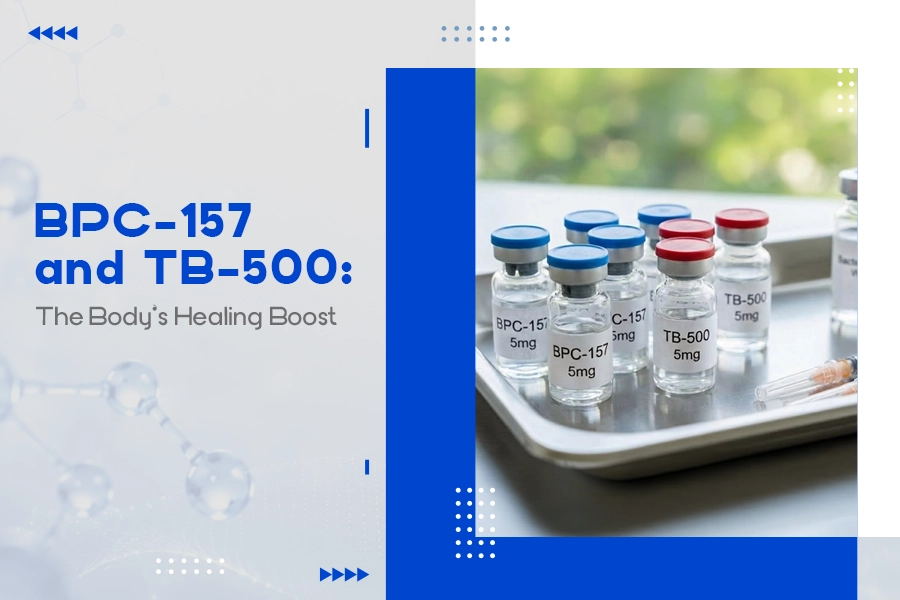
The Body Already Knows How to Heal – BPC-157 and TB-500 Are Just Reminding It
There’s something strange and almost uncomfortable about how fast certain peptides seem to work in research settings. Like, the kind of “wait, that’s not supposed to happen” fast. Rats with severed Achilles tendons walking again. Gut tissue is knitting back together. Inflammation cooling off before the expected timeline.
BPC-157 and TB-500 have been sitting in the middle of these kinds of conversations for years now, mostly in research labs, some in bodybuilding forums, and a little in the kind of biohacker content that gets shared quietly. But lately, the scientific side is catching up in ways that make it harder to dismiss.
So here’s what I’ve been piecing together.
What is BPC-157
BPC stands for Body Protection Compound. It’s a pentadecapeptide, 15 amino acids derived originally from a protein found in human gastric juice. Your stomach, basically.
The fact that it comes from gastric tissue is kind of wild when you start reading the research, because its effects seem to go way beyond the gut. Studies in rats have documented BPC-157 accelerating healing in Achilles tendons, ligaments, muscles, and even bone. One study by Krivic et al. looked at Achilles tendon-to-bone healing and found meaningfully improved functional and biomechanical parameters compared to control groups. Another study by Cerovecki et al. specifically looked at ligament healing and found that BPC-157-treated rats had less inflammation and better collagen organization.
That last part matters. Collagen organization isn’t just healing, it’s the quality of healing. The architecture of repaired tissue.
And TB-500
A lot of people use “TB-500” and “Thymosin Beta-4” interchangeably, but that’s not quite right. TB-500 is actually a synthetic fragment of thymosin beta-4, a peptide naturally found in high concentrations in blood platelets and wound fluid.
Thymosin beta-4 itself has been studied for its role in promoting endothelial cell migration and angiogenesis, the formation of new blood vessels. That’s what TB-500 essentially zeroes in on. When tissue gets damaged, one of the core problems is that the local blood supply gets disrupted. TB-500’s proposed mechanism is about fixing exactly that, stimulating endothelial migration and capillary formation, which is one of the foundational steps in tissue revascularization.
Without blood flow, healing stalls. With restored blood flow, the whole cascade of collagen deposition, immune response resolution, and new matrix formation can actually proceed.
That’s the idea, anyway. Still mostly preclinical evidence at this stage.
Why These Two Get Stacked Together in Research
Individually, both peptides are interesting. Together, they’re talked about a lot because their mechanisms seem to complement each other rather than overlap.
BPC-157 appears to work heavily through cytoprotective pathways and direct tissue signaling, the kind of healing that happens at the local injury site. TB-500, on the other hand, seems to operate more systemically, promoting vascular repair and cell migration that then supports the broader healing environment.
There’s a rough logic there: one acts locally on damaged tissue, and the other helps rebuild the infrastructure and the blood supply needed for comprehensive repair. Whether that synergy holds up in controlled human trials is still an open question.
Which brings me to the thing a lot of coverage skips over.
The Part Where Honesty Matters
Almost everything we have on BPC-157 and TB-500 is preclinical. Animal models mostly rodents.
A University of Washington review on peptide therapy for muscle rehabilitation specifically called out BPC-157’s compelling preclinical evidence but also noted that “further research is needed to validate these findings in human populations” and that rigorous clinical trials are still lacking.
That’s not a dismissal. Animal models are genuinely useful they’re how most promising therapeutics begin. But the jump from rat tendon healing to human clinical application is not small. Dosing, bioavailability, long-term safety profiles, and individual variation all matter in ways that rodent studies don’t fully capture.
The peptide research community seems to understand this. What’s frustrating is when that nuance disappears in popular coverage, which it does regularly.
The Gut Connection That Doesn’t Get Enough Attention
Most people who come across BPC-157 are interested in it for joints or muscles. But there’s a whole other area of research focused on its gastrointestinal effects.
Given that BPC-157 is derived from gastric juice proteins, this shouldn’t be surprising. Studies have looked at its potential role in colitis, intestinal inflammation, and even ischemia-reperfusion injury in the gut. Research has suggested it may support mucosal healing and have cytoprotective effects along the GI tract.
This is actually part of why some researchers find it compelling beyond just athletic recovery. If the peptide has a meaningful role in gut healing, the downstream implications for inflammation, immune function, and even systemic health could be more significant than the orthopedic angle alone suggests.
Tissue Repair at the Cellular Level – What’s Actually Happening
When researchers talk about peptide-driven healing, they’re usually pointing to a few specific biological pathways: angiogenesis, fibroblast migration, collagen remodeling, and satellite cell activation.
BPC-157 seems to influence the vascular and cytoprotective sides of that, basically signaling that keeps cells alive and directs healing resources to the right place. TB-500’s role in endothelial migration and capillary formation sits squarely in the angiogenesis piece of that picture.
Fibroblasts are the cells that produce collagen, the structural protein that makes tendons, ligaments, and skin what they are. Any peptide that meaningfully accelerates fibroblast activity or collagen organization is, in theory, accelerating structural healing. Not just symptom relief, but actual tissue architecture restoration.
That’s the part that gets the researchers genuinely excited.
Why This Research Area Keeps Attracting Attention in 2026
Chronic wounds. Musculoskeletal injuries. Post-surgical recovery. These are expensive, slow, and often inadequately treated by existing medicine. The US and UK healthcare systems are both dealing with enormous burdens around exactly these problems diabetic wounds, sports injuries, and orthopedic surgeries with long recovery windows.
Peptide-based approaches represent a different kind of intervention than traditional pharmaceutical drugs. Peptides are naturally occurring molecules. The body already makes versions of them. The hypothesis is that exogenous administration given from outside can amplify or accelerate biological processes that already exist.
That’s not a fringe idea. GLP-1 receptor agonists, the class behind drugs like semaglutide, are peptide-based. The success of that class has, in part, renewed broader scientific interest in peptides as viable therapeutics.
BPC-157 and TB-500 are still earlier in that pipeline. But the underlying science of peptides driving specific cellular healing mechanisms is being validated in adjacent fields at a notable pace.
What the Research Still Can’t Tell Us
This is where I want to be careful, because it’s genuinely unclear.
There are no large-scale Phase 3 clinical trials for BPC-157 or TB-500 in humans as of mid-2026. Most of what circulates online, whether in biohacker communities, research databases, or supplement forums, draws on animal studies, small observational data, or anecdotes.
That doesn’t make the research meaningless. It means it’s incomplete. The mechanisms are plausible. The preclinical evidence is genuinely interesting. The safety data in animals is generally favorable. But “generally favorable in rats” and “proven safe and effective in humans” are different statements, and conflating them is how people get hurt.
For the US and UK context specifically, it’s worth knowing that both BPC-157 and TB-500 are research chemicals in their respective markets.
The research is interesting. Science is developing. And the full picture, as it usually does, takes time.
FAQs
1. What is BPC-157 used for in research?
Primarily studied for tissue repair, tendons, ligaments, muscles, and gut healing based on preclinical animal models.
2. Is TB-500 the same as Thymosin Beta-4?
Not exactly. TB-500 is a synthetic version of a piece of thymosin beta-4 made to mimic some of its healing effects.
3. How can BPC-157 and TB-500 work together?
BPC-157 is more localized in its tissue level healing, whereas TB-500 promotes vascular repair and cell migration, so they work on different but related aspects of the healing process.
4. Has BPC-157 been tested in human clinical trials?
The problem is the lack of large human trials. Most evidence is from animal studies and researchers are still calling for rigorous clinical investigation.