
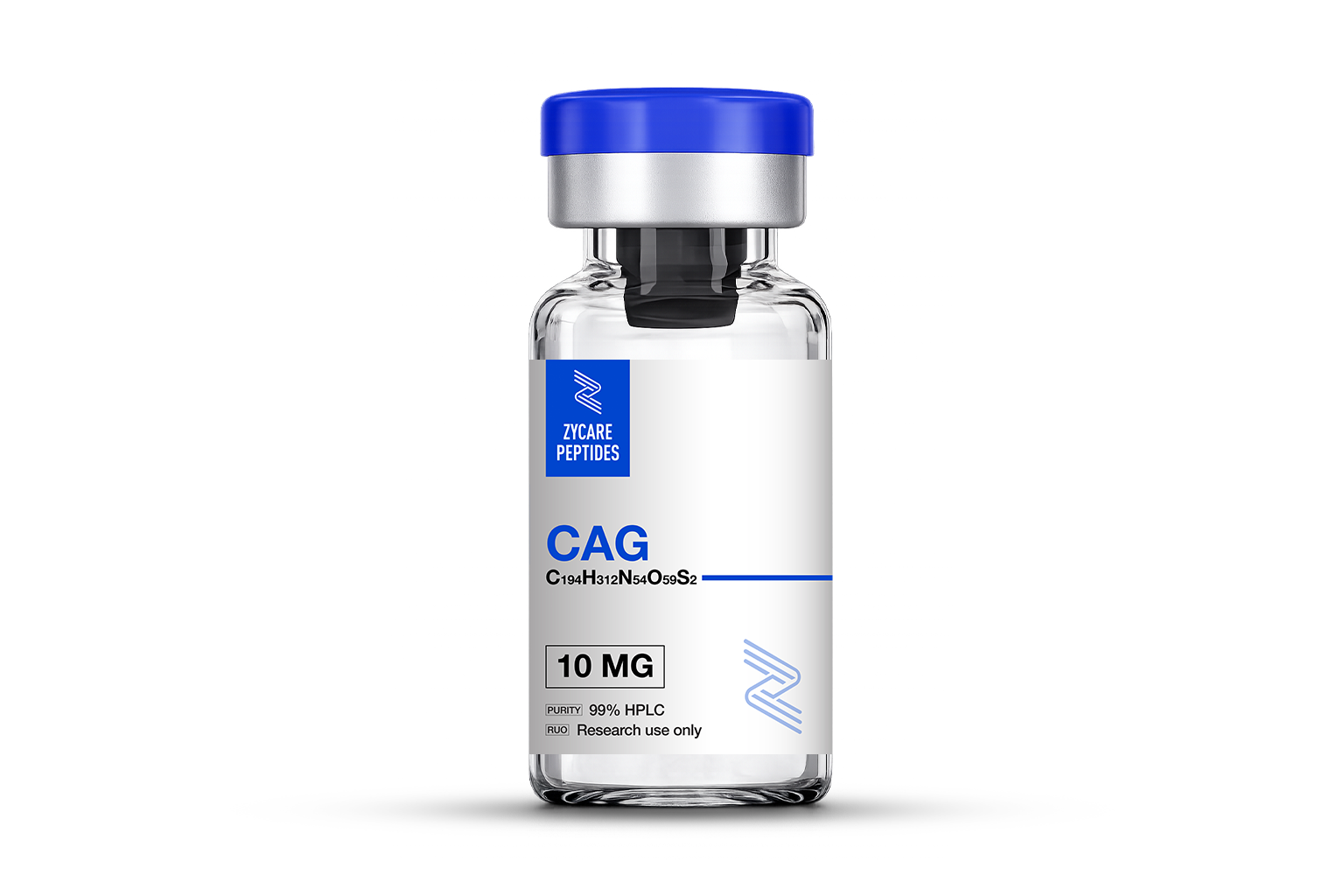


Cagrilintide (CAG) is a Carnosine-Arginine-Glycine a research peptide. It is a synthetic tripeptide analog of L-carnosine. 3 amino acids, with molecular weight 354 g/mol. Studied as an antioxidant, anti-glycation, and neuroprotective compound. More stable than L-carnosine due to Arginine substitution, giving better resistance to carnosinase degradation. White lyophilized powder, freely water soluble. Cagrilintide (CAG) chelates metals like Cu2+/ Fe2+ to block ROS from Fenton reactions. Scavenges reactive carbonyls MGO, GO to prevent AGE formation and protein crosslinking., buffers intracellular pH and may supports mitochondrial function in oxidative stress models.
Key Features
| About | |
| Drug Class | Antiglycation agent |
| Subclass | Carnosine analog, Tripeptide derivative |
| Active ingredient | CAG peptide |
| Cagrilintide (CAG) | |
| Composition | Active ingredients
CAG Peptide Inactive ingredients: Trifluoroacetate Bacteriostatic water 0.9% Nacl |
| Packaging Type | Sterile glass vial |
| Pack Size | 1 Vial 10 mg |
| Dosage | 10-100 mg/kg |
| Active ingredients | CAG Peptide |
| Shelf Life | Lyophilized, 2-8°C, protect from light and moisture |
| Usages | It is used only in laboratory research only, Research category, Antioxidant anti-glycation and neuroprotective. |
How does Cagrilintide (CAG) work?
- Metal chelation: Binds Cu²⁺, Zn²⁺, Fe²⁺ reduces Fenton reaction ROS.
- Anti-glycation: Scavenges reactive carbonyls like MGO, GO prevents AGE formation.
- pH buffering: Imidazole ring of carnosine moiety buffers intracellular pH.
- Neuroprotection: Shown in rodent models to decrease amyloid-β aggregation, decrease mitochondrial oxidative stress.
Research Application
Cagrilintide CAG (Carnosine-Arginine-Glycine) is used in:
- Anti-Glycation
- Neurodegeneration research
- Aging and Lifespan
- Oxidative stress and Mitochondria
- Muscle and Exercise models
- Ocular research
Research Dosage
- Rodent Neuro aging IP or SubQ can be 10-100 mg/kg/day.
- Diabetic AGE models, Oral in water can be taken 50-100 mg/kg/day.
Side effects and Interactions
Irritation, mild flushing, headache can be the side effects of CAG Peptide. It may interact with Antihypertensives like additive BP decreases risk via arginine. PDE5 inhibitors sildenafil NO potentiation lead to hypotension risk. Immunosuppressants, carnosine modulates some immune markers. Chemotherapy Antioxidants may interfere.
Pharmacokinetics
- Absorption: Poor oral, approx. 1-5%. SubQ/IP gives systemic exposure.
- Metabolism: Hydrolyzed by serum/tissue carnosinases to component AAs. Half-life in rodents approx. 15-30 min IV. More stable than L-carnosine.
- Distribution: Crosses BBB in rodents at high doses.
- Excretion: Renal as metabolites.
Product Specification
| Specification | |
| Peptide class | Synthetic tripeptide |
| Molecular structure | B-Ala-Arg-Gly |
| Purity (HPLC) | ≥ 98% |
| Appearance | White to off-white fluffy powder |
| Reconstitution | Sterile bacteriostatic water or 0.9% Nacl. |
| Solubility | Freely soluble greater than or equal to 50 mg/mL. |
| Storage (lyophilized) | −20°C, protected from light and moisture |
| Storage (reconstituted) | 2–8°C, use within 7-14 days |
Precautions
- Pregnancy, lactation, paediatrics, hepatic/renal impairment should avoid CAG Peptide.
- Purity: Must have COA, HPLC is equal to or greater than 98%, MS confirm MW. Acetate salt preferred.
- Herpes: Arginine may reactivate HSV-1/HSV-2.
- Be cautious in Hypotension, if baseline low BP or on nitrates.
- Cancer: Antioxidants have complex role. No CAG-specific data, but theoretical concern in some models.
Conclusion
Cagrilintide (CAG) is a Carnosine-Arginine-Glycine a research peptide. It is a synthetic tripeptide analog of L-carnosine. 3 amino acids, with molecular weight 354 g/mol. Studied as an antioxidant, anti-glycation, and neuroprotective compound. More stable than L-carnosine due to Arginine substitution, giving better resistance to carnosinase degradation. White lyophilized powder, freely water soluble. It may show some side effects like Irritation, mild flushing, headache etc. This is only for Research purpose it is not for human consumption, veterinary use or therapeutic application or any diagnostic purpose.
Related Research Peptides
You may also explore BPC-157, Tesamorelin, NAD+, and GLP-TZ peptides available at Zycare Peptides.
FAQs
What is Cagrilintide CAG?
Cagrilintide CAG is a Carnosine-Arginine-Glycine a research peptide. It is a synthetic tripeptide analog of L-carnosine. 3 amino acids, with molecular weight 354 g/mol. Studied as an antioxidant, anti-glycation, and neuroprotective compound.
What for Cagrilintide CAG is used according to research?
Cagrilintide CAG is a Carnosine-Arginine-Glycine is used in research in studying antioxidant, anti-glycation, and neuroprotective compound.
How does Cagrilintide CAG work?
Cagrilintide CAG works by chelating metals like Cu2+/ Fe2+ to block ROS from Fenton reactions. Scavenges reactive carbonyls MGO, GO to prevent AGE formation and protein crosslinking., buffers intracellular pH and may supports mitochondrial function in oxidative stress models.
What can be the possible side effects of CAG?
Irritation, mild flushing, headache, low BP, can be the possible side effects of CAG Peptide.
Is CAG the same as L-carnosine?
No, this are not same as L-carnosine is beta-Ala-His and CAG is Beta-Ala-Arg-Gly, where CAG has better serum stability and stronger metal chelation.
| Note: Cagrilintide CAG is only for Research purpose it is not for human consumption, veterinary use or therapeutic application or any diagnostic purpose. |



Daniel Philip –
CAG has been easy to use and fits perfectly into my routine. The product quality appears excellent and consistent.